By Sam Lyne (SEO – Metric Hub)
How many times have you seen an ad on Google and actually clicked on it?
I’ll be totally honest, as an SEO, I put my faith in organic results, though perhaps I’m just being biased there.
And that’s the thing about search behaviour: we all have our own little ways of interacting with results.
Despite my own search habits, there’s a good reason Google’s Ads have been around since the start of this century.
In 2025, Google’s total advertising revenue alone reached $294.69 billion. That doesn’t mean every ad campaign is profitable, of course. But it does show the sheer scale at which businesses continue to invest.
Let’s take a deeper look at whether Google Ads are worth the investment and if people genuinely click on them…
The Short Answer: Yes, They Do
The truth is, millions of people interact with paid search results.
Google Ads remains one of the world’s biggest advertising platforms, with businesses continuing to generate measurable traffic, leads and sales through paid search.
According to Demandsage, over 63% of people have clicked on a Google ad. So, even if it’s not your preference, most of us have probably clicked a search ad at some point.
That’s not to say that 63% of every group of searchers clicks an ad, though.
There’s a difference between asking somebody whether they’ve clicked a Google Ad and measuring the click-through rate of a single campaign.
The CTR (click-through rate) of Google PPC ads is calculated by dividing an ad’s clicks by the number of times it was shown. That percentage can differ enormously depending on the industry, query, ad position and the user’s intent.
So in essence, someone may click on an ad, but that doesn’t necessarily mean they will make a purchase or sign up to a service.
A click simply tells us the ad generated enough interest for someone to explore further. It’s exactly why clicks alone don’t tell us whether a campaign is truly successful.
How We Can Measure Google Ad Clicks
This is where CTR becomes useful. It tells us how often an ad generates a click after being shown, giving us an indication of how effectively it’s attracting attention from users.
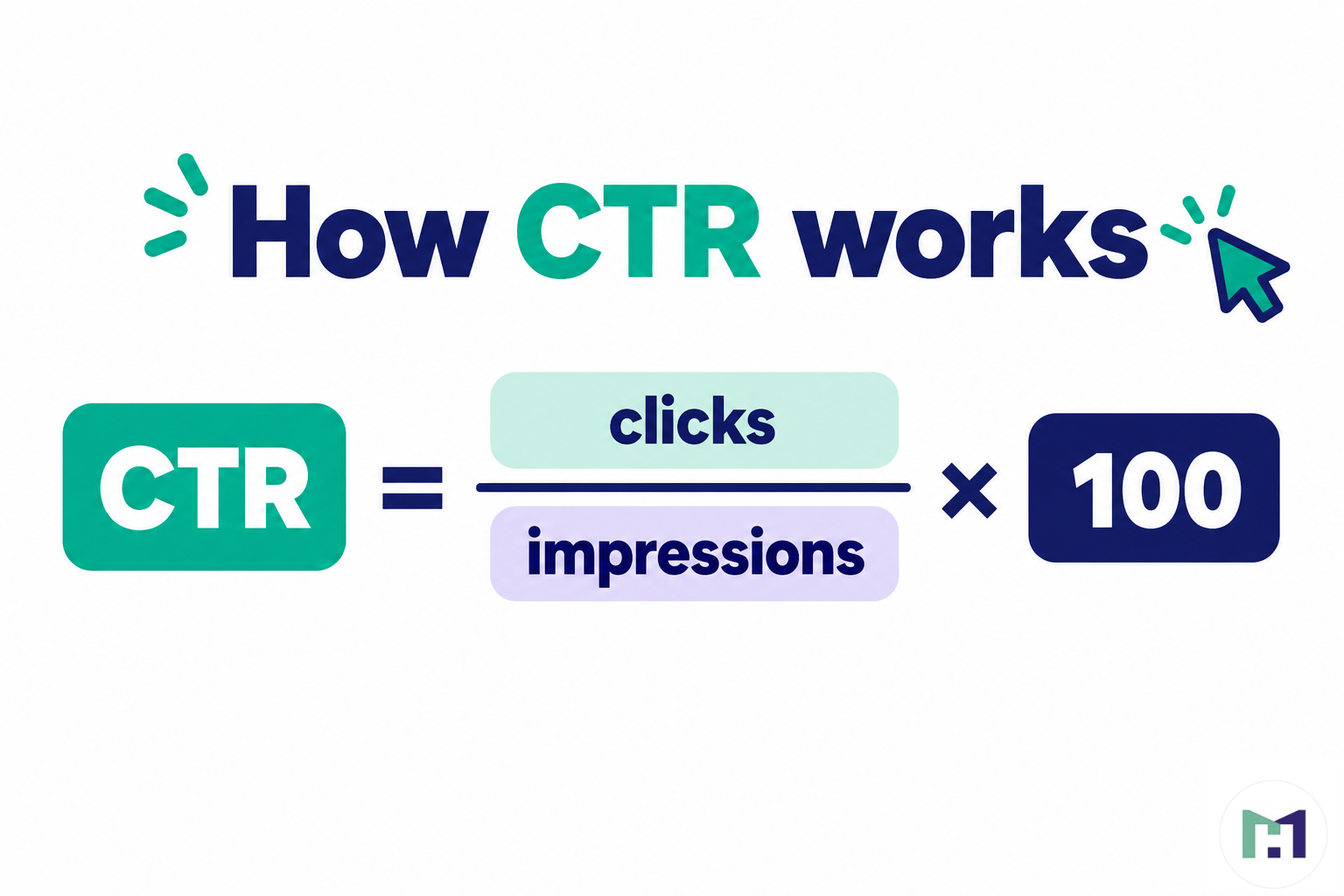
Let’s say your advert receives 10,000 impressions and generates 600 clicks − that’s a 6% CTR.
That doesn’t mean 6% of all Google users clicked it. It means that particular advert generated a click on 6% of the occasions on which it was shown.
A big part of this comes down to the intent behind the search.
So we know people click Google Ads. But that still leaves a few obvious questions. Are people clicking because they don’t realise they’re adverts? Does everyone secretly prefer organic results? And does a click actually mean an ad is working?
Let’s bust a few of those myths.
“People Will Ignore Anything That Says Sponsored”
You may be thinking – surely people are going to skip anything labelled Sponsored?
Some do. Many don’t. It’s all about what they’re looking for.
Google labels results as sponsored for a good reason – transparency.
By labelling which results are ads, Google maintains trust with users by making it clear which listings have been paid for.
For example, let’s say you need an emergency plumber.
You fire up Google and the first Sponsored result says something like:
Emergency Plumbing (location) | 24/7 Callouts | Call Now
If you’ve got water coming through your ceiling, you may care much more about whether the company can help immediately than whether the listing has been paid for.
So we can recognise something as an advert and still deliberately choose it because it answers a query.
Of course, the Sponsored label isn’t a seal of approval for the business behind the ad. Searchers still need to decide whether they trust the company, offer and website.
Being paid for doesn’t automatically make a result irrelevant. So as long as the ad closely matches what someone needs, clicking on it may still make perfect sense.
“People Always Prefer Organic Search over Paid”
SEO and PPC both have their benefits, and together they make a powerful digital media strategy.
As someone working in SEO, my eyes naturally gravitate towards organic results. But that’s my search behaviour, not everybody else’s.
It’s been said that organic search drives 53.3% of all website traffic, with just 15% for paid search (BrightEdge).
Sure, SEO tends to get more traffic and clicks, but organic results can serve a different purpose to ads.
A user can click on an organic result, whether that’s a product page or blog, but that doesn’t necessarily mean they’ll make a purchase. Meanwhile, paid campaigns can be used to target searches with stronger commercial intent.
But it’s the search itself, rather than the fact that someone clicked an ad, that gives us clues about what they want to do next.
It’s not that organic gets more clicks (that we already know). But that doesn’t make paid clicks any less valuable under the right circumstances.
Think of it like this:
A shop on the high street doesn’t need every person to enter.
What it needs is enough of the right people to walk through the door.
“People Hate Ads, So Why Would They Click On One?”
How many times have you seen an advert on TV over and over again?
The Go Compare guy, those Haribo adverts where they’ve dubbed kids’ voices over adults, Domino’s domino-hoo-hoo. We can definitely do without them.
So why would people deliberately click on a pay-per-click ad in Google Search?
The distinction here is:
People don’t choose to click because they love advertising.
They click because the result looks useful for what they’re trying to find.
When an ad closely matches the intent behind a search and communicates the message clearly, it has a much better chance of earning the click.
Search ads don’t behave like most other ads, either.
A good Search Ad can reflect the product, service, location, problem, offer and next step far more directly than most traditional forms of advertising.
There’s a big difference between being in the middle of a YouTube video and having a relevant ad show up in your search results.
Individual headline assets are limited to 30 characters, so advertisers have to communicate their relevance right there and then.
From a user’s perspective, it can make it easier to spot a result that matches what you’re looking for.
“Every Search Has the Same Chance of Producing an Ad Click”
Two people can search for something similar, and still be trying to achieve completely different things. Whether they are likely to click an ad depends heavily on why they’re searching in the first place.
Let’s take a nice broad search like “home insurance”, for example.
One person might be looking for information on how it works, why it’s worth buying or how much it can cost. In that case, a detailed guide found organically might be just what they need.
Someone else, however, might search “compare home insurance quotes” or “buy home insurance online”. Because they’re actively looking for a product they may be more receptive to certain insurance PPC ads.
Some informational searches are naturally less suited to commercial ads.
For example, if you’re searching “how does home insurance work” you may be more inclined to choose an organic result over an ad focused on buying the product.
Likewise, there are some searches that may favour ads, particularly shopping and service-based queries.
A search for something like “how long do nike trainers last?” and “cheap nike air max” mention the same brand, but they suggest different intentions. It’s the latter that gives you a much clearer opportunity.
“A High Click-Through Rate Means Your Google Ads Are Working”
Getting people to click on your ad sounds like success. After all, isn’t that what you’re paying Google for?
Not quite.
As we’ve already mentioned, CTR measures the percentage of impressions that result in a click.
A higher CTR can suggest that your ad is doing a good job of attracting attention. It doesn’t necessarily mean the campaign is successful.
An ecommerce business might run ads specifically to generate sales. If an ad itself attracts plenty of clicks but very few purchases, the problem could sit with the targeting, the offer, the landing page, or somewhere else in the journey.
What Is a Good Google Ads CTR?
So, what CTR is actually good for a Google Ad?
A 2026 study from Wordstream by LocaliQ found that “the average click-through rate in Google Ads in 2026 was 6.64%” across all industries.
That gives us a useful benchmark. However, it’s not a universal target as a CTR can vary between industries.
Despite all of this, the success of an ad can often boil down to several factors including:
- The industry
- Search intent
- Competition
- Brand recognition
- Device
- Position
- Geography
- Whether the search is branded or non-branded.
The takeaway from this is that CTR tells you whether people are responding to your ad. But it doesn’t tell you whether they’re becoming customers.
The table below is a perfect example, of how a PPC ad can generate clicks but still fail to deliver meaningful results:
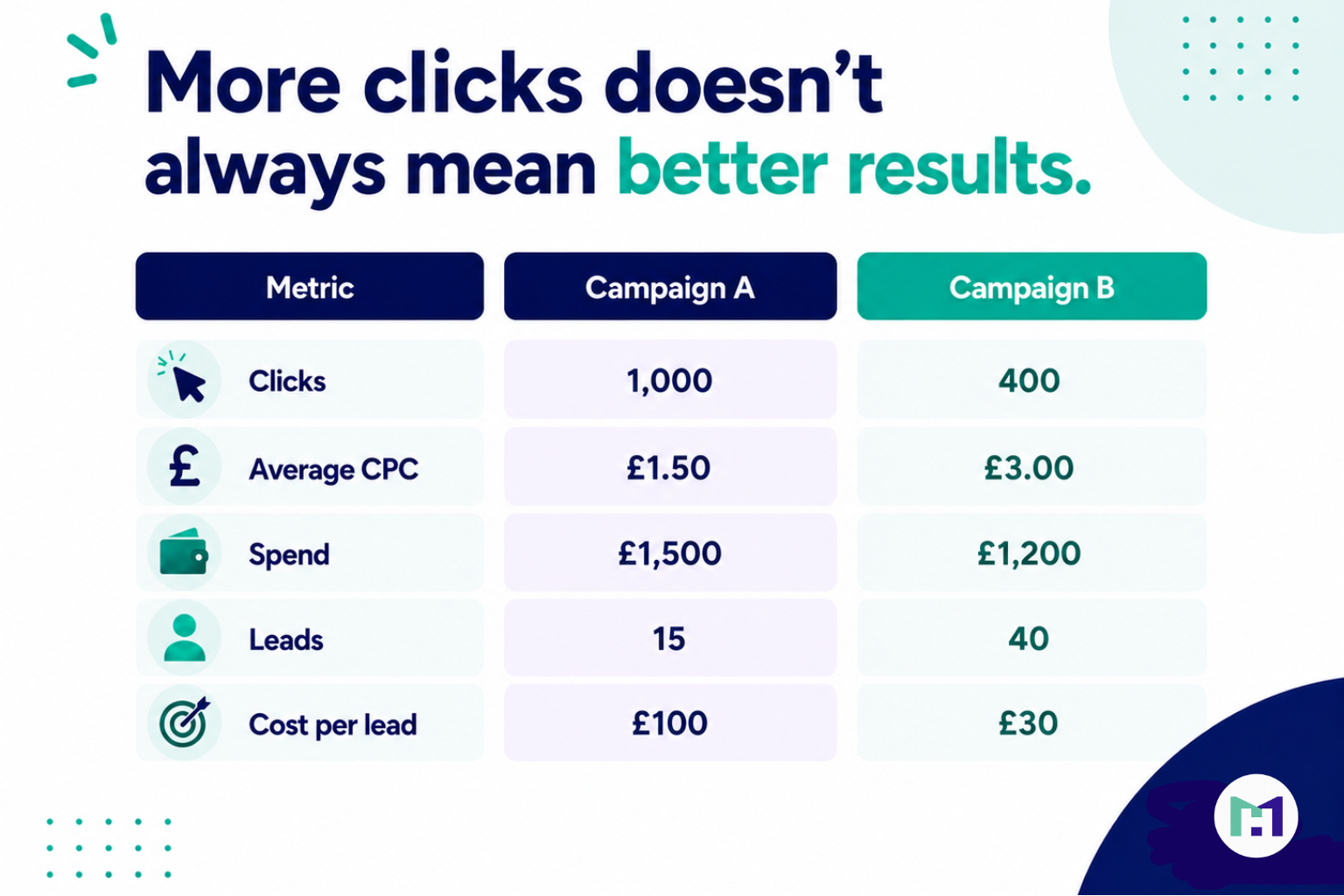
As you can see, Campaign B not only cost less overall, it also generated more leads which is ultimately more beneficial for the business despite having lower clicks than A.
A is great if you’re purely measuring clicks.
However, it’s B that looks far stronger from a business perspective.
“If My Ads Aren’t Working, Google Ads Don’t Work”
Some Google Ads campaigns succeed and some fail. That’s like any form of advertising.
However, the failure of a campaign isn’t necessarily a reflection of the products or services being offered.
Nor does a poor campaign performance prove that Google Ads doesn’t work as a whole. The opposite isn’t automatically true either.
Sometimes the issue is the campaign, while other times the economics or markets may not be right for that particular strategy.
There are plenty of reasons a PPC campaign can fail, including:
- Poor keyword targeting
- Irrelevant searches
- Weak ad messaging
- Bad geographic targeting
- Ineffective landing pages
- Poor conversion tracking
- Uncompetitive pricing
Some businesses, markets or offers just aren’t ideally suited to certain ad strategies. An ad may lead people to your site, though what happens after the click plays a huge role in whether it’s a success.
Sometimes the ad did its job in terms of clicks, but the wider customer journey didn’t.
That’s why it’s not about creating the ads alone. There needs to be genuine PPC expertise leading it.
“PPC Ads Are Either Worth It or They Aren’t”
If there’s one thing that’s certain, there’s no one universal verdict on whether PPC works or not.
It all really depends on whether the economics work for that particular business and how useful it is to the user.
A really niche business may see less benefit than one that has broad appeal. However, even niche markets can have success if the campaign reaches the right audience.
So if you’re running ads for “pink christmas trees” in the middle of summer, you’ll have better luck finding the Loch Ness Monster.
But if you run that at the right time – say, right as Michael Bublé is released from cryogenic storage – your ad would be far more relevant and have a much better chance of generating conversions.
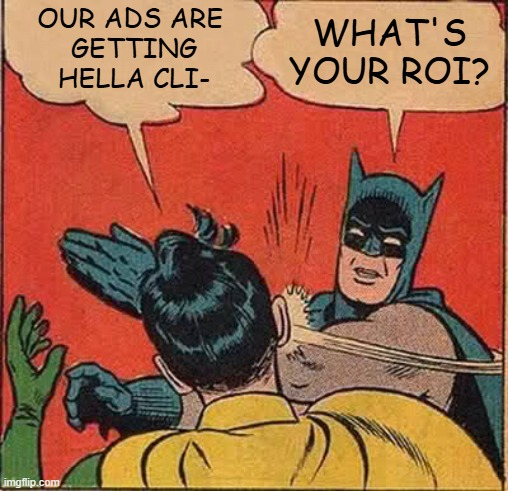
As far as costs are concerned, it’s essential to weigh the investment against the potential return.
If a new customer is worth £500+ in gross profit before ad costs, spending £100 to win their business may make perfect sense.
On the flip side, if they’re only worth £50, the numbers simply don’t add up.
That’s the same Google Ads platform, but a completely different result.
If you’re not sure whether PPC is right for you, it’s definitely worth speaking to someone who knows the ins and outs. Speak with our PPC team today to see how we can help.
Conclusion: People Really Do Click Google Ads
If there’s one thing we can take from all of this, it’s that people do click on search ads – so there’s that myth busted.
For a business, though, that’s not really the question that matters. It’s whether the right people are clicking, and if those visits are enough to turn a profit.
A campaign can generate plenty of traffic and still fall flat if those visitors don’t take the next step. At the same time, a smaller number of well-targeted clicks can be far more valuable when they’re coming from people actively looking for what you offer.
That’s where Google Ads can become a powerful part of a wider marketing strategy. When the targeting, messaging, landing pages and tracking work together, paid search can put your business in front of potential customers at exactly the moment they’re ready to act.
Clicks certainly matter, but the real value of a PPC ad comes from what happens next.
